AI Search Optimization: The Field Guide for Local Service Businesses
Written by Scott Mader | Human (not AI)
ChatGPT processes over 2.5 billion searches every day. [Techcrunch]
Google’s AI answers questions before anyone clicks a link. Perplexity is recommending lawyers, contractors, accountants, plumbers, HVAC companies, and service businesses — right now — to customers in your market.
The question isn’t whether AI search is happening. The question is whether your business is being recommended or passed over.
This is the complete field guide to AI Search Optimization for local service businesses — what it is, how it works, and exactly what it takes to get recommended.

The Way Customers Find Local Businesses Has Fundamentally Changed
The customer journey that traditional SEO marketing was built for no longer describes how the majority of customers find and hire service businesses.
Here is what the data shows right now:
Why Traditional SEO No Longer Protects Your Business
Traditional search engine optimization was built for a world where customers typed short keywords into Google, received a list of links, and clicked through to browse multiple websites. That world is fading fast.
AI search works through an entirely different process. Understanding the difference is the first step to winning. Today, people let AI do the sorting and vetting and then simply call or click directly from the AI response. All of this without ever going to a website! That’s know as a “zero click search”.
How Traditional SEO Works
How AI Search Works
AI systems like ChatGPT, Perplexity, Claude and Google’s AI Overviews reward something different entirely:
- Entity clarity — Does AI confidently understand who you are, what you do, where you serve, and why you’re credible?
- Content extractability — Is your content structured in formats AI can lift, quote, and cite?
- Trust signals across the web — Do reviews, directories, schema markup, and third-party mentions confirm your credibility from multiple independent sources?
- Differentiation — Does your online presence give AI a specific reason to recommend you over a generic competitor?
The critical difference: AI doesn’t use GPS the way Google does. It relies on explicit geographic mentions in your content, reviews, and citations. If your service areas aren’t woven throughout your online presence in natural language, AI doesn’t know where you operate — and won’t recommend you locally.

What Happens to Businesses That Don’t Adapt
Research on businesses that have optimized for AI search versus those still relying on traditional SEO shows a clear and widening gap:
- AI-optimized businesses receive 40–60% more qualified leads than businesses with comparable traditional SEO performance
- Leads from AI citations convert at 30–50% higher rates than traditional search traffic
- The citation gap compounds monthly — early movers build authority that becomes progressively harder for competitors to overcome
Every month of delay is a month your competitor can plant their flag on the answer to a question your customer is asking right now.
Let’s Discuss AI For Your World
Elevate Your Business with Expert AI Advice
How AI Engines Decide Who to Recommend
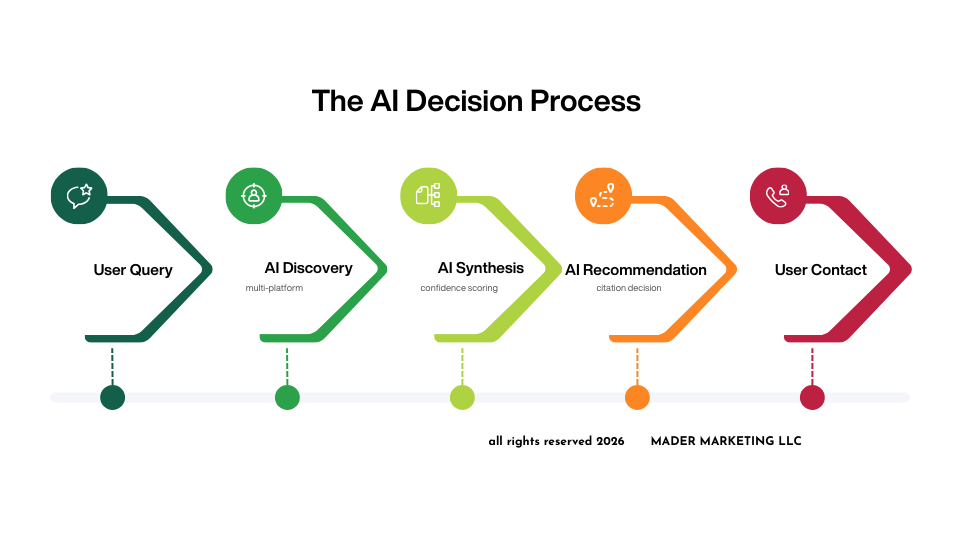
Understanding this process is your competitive intelligence. Every step represents an opportunity — or a failure point.
AI systems move through three distinct stages before a customer ever sees a recommendation.
Stage 1 — AI Discovery (Multi-Platform)
AI doesn’t just look at your website. It scans your entire digital footprint across:
- Your website and its content structure
- Google Business Profile and review platforms
- YouTube, Reddit, and industry forums
- News mentions and industry publications
- Professional directories and citation sources
- Social media presence and engagement
What this means for your business: A business with a website and nothing else gives AI very little to work with. A business with strategic presence across multiple platforms gives AI rich, cross-verifiable information — and earns higher confidence.
Stage 2 — AI Synthesis (Confidence Scoring)
Once AI discovers your information, it synthesizes what it finds to build a confidence score. This is where E-E-A-T (Experience, Expertise, Authoritativeness, Trustworthiness) becomes critical.
AI is asking itself:
- Does this business have documented, verifiable experience?
- Does their content demonstrate genuine expertise — or generic claims?
- Do third parties independently confirm their credibility?
- Is their information consistent and transparent across all platforms?
Businesses that communicate clear differentiation get synthesized as uniquely appropriate for specific scenarios. Businesses with generic messaging get filed as undifferentiated category members — present, but unremarkable.
Stage 3 — AI Recommendation (Citation Decision)
When a customer asks AI a question, the recommendation draws from everything synthesized in Stage 2. The AI selects businesses based on:
- How well the business matches the specific query
- The AI’s confidence level in that business
- How the business compares to alternatives in the same area
The result: High-confidence businesses get cited frequently and prominently. Low-confidence businesses rarely get mentioned — regardless of their actual quality or Google rankings.
Intelligence note: 71% of keywords triggering AI Overview results have a keyword difficulty score below 30. The competitive terrain is still accessible. But the window to establish early authority is closing as more businesses recognize the opportunity.
What Is AI Search Optimization for Local Service Businesses?
AI Search Optimization (also called AEO — Answer Engine Optimization, or GEO — Generative Engine Optimization) is the practice of building a business’s online presence specifically to be discovered, understood, and recommended by AI search systems.
It is not traditional SEO. It is not paid advertising. It is not social media marketing alone.
AI Search Optimization is a systematic, multi-channel process that builds the signals AI systems need to confidently recommend your business when a customer asks a relevant question.
What AI Search Optimization Is NOT
- It is not about ranking #1 on Google for short keywords
- It is not a one-time website update
- It is not something template marketing platforms like Thryv or Hibu can deliver at scale
- It is not about gaming an algorithm
What AI Search Optimization IS
- A systematic build of your authority, identity, and credibility across the entire web
- A content strategy built around the exact questions your customers are asking AI right now
- A trust signal architecture that gives AI systems multiple independent reasons to recommend you
- A long-term competitive position that compounds over time and becomes harder for competitors to overcome
The Five-Pillar AI Search Battle Plan for Local Service Businesses
Most marketing companies approach AI search the same way they approach everything else — with tactics thrown at a problem without a system. The AI General runs a structured, repeatable operation built on five strategic pillars executed in the right sequence every month.
Pillar 1 — Fortify the Foundation
Schema markup · Citation consistency · Internal linking · People Also Ask optimization
Every strong operation starts with a secure base.
Schema markup formally introduces your business to AI systems using structured code that identifies your business type, services, service areas, staff credentials, reviews, and FAQs. Without it, AI must guess who you are. With it, AI knows.
Citation consistency eliminates contradictions. When your business name, address, phone number, and service descriptions appear differently across directories and platforms, AI registers uncertainty. Uncertainty means exclusion. Every citation must match.
Internal linking builds a clear map of your expertise that AI can follow from topic to topic across your site.
People Also Ask optimization positions your content precisely where AI is already looking for answers — inside the question patterns real customers use when they search.
Pillar 2 — Intelligence and Targeting
Long-tail keyword research · Neighborhood targeting · AEO intent analysis
Good intelligence wins battles before they’re fought.
AI search is dominated by long-tail queries — questions four words or longer. Old SEO targeted “best HVAC Cincinnati.” AI search answers “What is the best HVAC company in Cincinnati for emergency repairs on older homes?”
Using tools like AHREFS and Ubersuggest, we identify the specific long-tail questions your customers are already typing into AI platforms. We map those questions to your exact service neighborhoods — because AI doesn’t use GPS proximity the way Google does. AI relies on explicit geographic language embedded in your content, reviews, and citations.
We find the content gaps your competitors haven’t covered and we take that ground first.
Key targeting stat: 99.2% of AEO (AI answer engine) searches are informational in nature. The mission is to own the informational answers — then convert the traffic those answers produce.
Pillar 3 — Deploy Authority Content
Cornerstone pages · FAQs · Case studies · Comparison guides · Troubleshooting content · Video
This is the engine room of the entire operation.
AI systems extract content from sources that directly answer questions with specificity and depth. Generic service descriptions and brochure-style copy get passed over. Authoritative, question-answering content gets cited.
Five content formats that generate disproportionate AI citation frequency:
- Descriptive H2 headers that match natural query language exactly (e.g., “How to Choose an HVAC Company for an Emergency Repair” — not “Our Services”)
- Front-loaded answers where the direct answer appears in the first 2–3 sentences of every section — not buried in paragraphs
- Bullet points and numbered lists that AI can extract 5x faster than dense prose
- FAQ sections built around actual customer questions — the single highest-cited content format in AI responses
- Extractable standalone statements — sentences that communicate complete, citable meaning on their own
Research shows businesses that restructure existing content into these five formats see 40–60% increases in AI citation frequency — with the same underlying information. Structure is as important as expertise.
Pillar 4 — Command Your Brand Story
Unique Selling Proposition · Founder’s story · E-E-A-T signals · Author authority
In AI search, a clear and distinct identity isn’t a marketing nice-to-have. It’s a tactical requirement.
Generic businesses get generic treatment. AI has no reason to recommend a business that describes itself the same way every competitor does. The businesses being cited most frequently have communicated clear, specific characteristics that give AI a specific reason to recommend them for particular needs.
This pillar develops:
- Your Unique Selling Proposition — the specific differentiation that makes you the obvious choice for your ideal customer
- Your founder’s story — structured as citable authority content using StoryBrand principles
- E-E-A-T signals — documented experience, demonstrated expertise, verifiable credentials, and transparent business identity
- Author authority — properly attributed content with credentials that AI systems treat as expertise confirmation
The Madison Avenue principle applies here: David Ogilvy didn’t write ads about generic quality. He found the one specific thing that made a product unforgettable. AI search rewards the same discipline.
Pillar 5 — Earn and Leverage Trust
Review strategy · Review language · Brand mention monitoring · AI visibility tracking
Reviews are not just for humans. AI systems read review language to understand your business.
When a review mentions your service area, a specific staff member by name, a particular outcome, or a neighborhood — AI absorbs that language as signal. It builds a picture of your business from thousands of real customer descriptions.
This pillar deploys a review strategy designed to generate the language that strengthens your AI profile — not just your star rating. Then we track your growing AI citation frequency across platforms so you can see the mission progressing in measurable numbers.
What good review language looks like for AI:
- Mentions specific service type performed
- Names the neighborhood or city
- Describes a specific outcome or result
- References staff professionalism or expertise
- Addresses a concern or question the customer had before hiring
The System Works. Here’s the Proof.
Our specialized AI search strategies drive success for local businesses.
Buckeye State Awnings
Visible in relevant ChatGPT and Gemini searches within 8 days of website launch. Not 8 months. 8 days.
BGM Wind & Shade
Appearing in AI search results before the website was even published. The authority signals were strong enough that AI cited the business before a single page went live.
Central Florida Awnings
AI search results strong enough that SunPro Corporate invited Scott Mader to their Bradenton training facility to teach their entire dealer network the same system.
These results are the baseline expectation — not the exception.
E-E-A-T — The Trust Currency That Drives AI Recommendations
Google’s E-E-A-T framework — Experience, Expertise, Authoritativeness, Trustworthiness — was originally designed to guide human reviewers assessing search result quality. It has become the primary mechanism through which AI systems determine whether to recommend a business.
What Is Experience in AI Search?
Experience signals prove your business has actually done the work you claim to do — with real clients, in real situations, producing real results.
Strong experience signals include:
- Case studies documenting specific client challenges, approaches, and measurable outcomes
- Before-and-after evidence with photos, data, or performance metrics
- Detailed testimonials describing specific problems solved — not just generic praise
- Portfolio content showing breadth of work across different scenarios
The difference AI recognizes: Claiming “20 years of HVAC experience” is a statement. Documenting a specific case study where you solved an emergency heating failure for a historic home in February — that is demonstrated experience AI can extract and cite.
What Is Expertise in AI Search?
Expertise signals show your content goes beyond basic information — that you possess genuine depth of knowledge that only practitioners understand.
Strong expertise signals include:
- Original content addressing complex, niche, or advanced scenarios
- Author bios with documented credentials, certifications, and professional background
- Content that addresses edge cases, uncommon problems, or specialized applications
- Industry certifications prominently displayed and verifiable
What Is Authoritativeness in AI Search?
Authoritativeness is the only E-E-A-T signal that cannot be self-claimed. It must come from how others treat and reference you.
Strong authoritativeness signals include:
- Mentions in industry publications, news articles, or local media
- Backlinks from relevant, credible websites in your industry
- Awards or recognition from professional associations
- Speaking engagements or expert quotes in third-party content
What Is Trustworthiness in AI Search?
Trustworthiness signals demonstrate your business is transparent, verifiable, and consistent across all platforms.
Strong trustworthiness signals include:
- Complete, consistent business information across every platform
- Transparent ownership, physical location, and contact details
- Review authenticity and consistency across Google, Yelp, and industry-specific platforms
- Clear privacy policies and verified business registration
The core E-E-A-T insight: Most small businesses have the underlying qualifications these signals represent. The gap is almost never in actual expertise or trustworthiness. The gap is in documented, visible, verifiable evidence of those qualities. AI can only evaluate what it can see.
How to Structure Content So AI Cites Your Business
The structure of your content determines whether AI extracts and cites it — independent of how good the information is. Research confirms that the same information restructured into AI-optimized formats generates 40–60% more citations.
Why Content Structure Matters for AI Citation
AI systems identify extractable information through structural signals: headers marking topic boundaries, list formatting identifying discrete items, question-answer pairs matching query patterns. Content without clear structural signals generates less extraction confidence — and fewer citations.
The Five Content Formats That Generate the Most AI Citations
1. Descriptive Headers That Match Natural Queries
Headers should use the exact natural language customers type into AI. “How to choose a contractor for a bathroom remodel” gets cited. “Our Process” does not. Research shows content under descriptive headers gets cited 3x more than content under generic or creative headers.
2. Front-Loaded Direct Answers
AI extracts from section beginnings disproportionately. The first 2–3 sentences of any section account for approximately 70% of citations. Place your direct answer first. Provide context and explanation after. This single structural change produces measurable citation increases with zero new information created.
3. Bullet Points and Numbered Lists
Lists are processed by AI 5x faster than paragraph prose containing identical information. Any information that can be presented as discrete items — criteria, steps, options, features, examples — should be formatted as a list.
4. FAQ Sections Built Around Actual Customer Questions
FAQ content achieves the highest citation frequency of any content format because its structure perfectly mirrors the query-answer pattern AI systems use. Questions should be phrased as customers actually ask them — not as topics or themes. A minimum of 15–30 comprehensive FAQ pairs is the baseline for meaningful AI citation impact.
5. Standalone Extractable Statements
Each sentence should communicate complete meaning independently. AI may extract any single sentence from your content and cite it in a response. If that sentence requires surrounding context to make sense, it won’t be cited cleanly.
How We Measure Your AI Search Visibility — The 60-Day Audit Framework
Most businesses have no idea where they currently stand in AI search. They assume traditional Google rankings indicate overall visibility — unaware that AI citation patterns operate independently of search rankings.
The AI General uses a systematic 60-Day AI Search Audit as the foundation of every client engagement.
What the 60-Day AI Search Audit Measures
Baseline citation testing: We submit 20–50 query variations across ChatGPT, Perplexity, Google AI, and other platforms. We track how often your business is mentioned, how prominently, and how competitors compare.
Citation frequency benchmarks:
- Below 10% citation rate = severe visibility gaps
- 10–30% = weak visibility requiring substantial improvement
- 30–50% = moderate visibility with clear optimization potential
- 50%+ = strong visibility — now optimize for prominence
Multi-dimensional readiness assessment: We audit four dimensions of AI readiness:
- Discovery — breadth of presence beyond your website
- Synthesis — differentiation clarity and E-E-A-T signal strength
- Extraction — content structure and format optimization
- Conversion — ability to convert AI-driven traffic that lands anywhere on your site
What Businesses Achieve Through the 60-Day Audit
Businesses starting with citation rates below 10% typically reach 25–35% by Day 60. Businesses starting at 30–40% typically reach 50–60%. Beyond frequency, the quality of citations improves — AI begins describing businesses with specificity, citing their differentiation, and recommending them for particular scenarios rather than just listing them generically.
The lead flow impact is direct: businesses that complete the audit framework and implement priority improvements typically see 40–60% increases in qualified lead flow within 90–120 days.
The High Ground Is Still Available — But Not for Long
In 2024, AI search was an experiment. In 2025, it became the default discovery mechanism for millions of daily searches. In 2026, businesses that moved early are already capturing leads their competitors will never know existed.
The strategic intelligence is clear:
- 71% of keywords triggering AI Overview results have a difficulty score below 30 — the terrain is still accessible
- Early citation frequency compounds — businesses cited frequently now build authority that becomes progressively harder for later adopters to overcome
- Template marketing platforms (Thryv, Hibu, Vivial) are 6–18 months behind in AI capabilities, based on their historical pattern of adapting to major market shifts
- Your competitors — in most local service markets — have not yet optimized for AI search
The window to establish early authority is real. But it measures in months, not years.
Scott Mader
CEO- The AI General
Founder- MADER MARKETING LLC

Frequently Asked Questions
What is AI Search Optimization for small businesses?
AI Search Optimization is the practice of building a small business’s online presence so it gets discovered, synthesized, and recommended by AI systems like ChatGPT, Perplexity, and Google’s AI Overviews. It differs from traditional SEO in that it focuses on AI citation frequency rather than Google keyword rankings. The goal is to ensure that when a potential customer asks an AI tool for a recommendation in your category and location, your business is named.
How is AI search different from Google search for local businesses?
Traditional Google search ranks businesses by proximity (GPS-based), ad spend, and keyword optimization. AI search systems do not use GPS at the moment of search. They rely on explicit geographic mentions in a business’s content, reviews, and citations to understand where a business operates. AI also rewards content that directly answers questions in extractable formats — FAQs, bullet lists, case studies — over keyword-dense brochure copy. The result is a completely different set of optimization requirements.
Does my business need to be on ChatGPT specifically?
No. AI Search Optimization builds your visibility across all AI platforms simultaneously — ChatGPT, Perplexity, Google AI Overviews, and others — by strengthening the underlying signals all these systems use to evaluate businesses. You optimize the signals; the citations follow across platforms.
What signals do AI systems use to recommend local service businesses?
AI systems evaluate local service businesses through three primary signals. First, entity clarity — consistent, comprehensive business identity across all platforms. Second, content extractability — content structured in formats AI can lift and cite, particularly FAQ pages, bullet lists, case studies, and descriptive headers. Third, trust signals — reviews mentioning specific services and locations, schema markup, directory citations, and third-party mentions that independently confirm credibility.
How long does AI Search Optimization take to produce results?
Most businesses see measurable improvements in AI citation frequency within 60–90 days of systematic optimization. Significant lead flow increases typically materialize within 90–120 days. Like all authority-building, AI Search Optimization compounds over time — early improvements accelerate subsequent gains rather than plateauing.
Can my current website be optimized for AI search or do I need a new one?
In most cases, existing websites can be restructured and enhanced for AI citability without a complete rebuild. The most impactful changes involve content restructuring (adding FAQ sections, restructuring headers, front-loading direct answers), schema markup implementation, and citation consistency across the web. A complete rebuild is rarely necessary — but the content and structure must change substantially from traditional SEO approaches.
Why can’t Thryv, Hibu, or my current marketing company handle AI Search Optimization?
Template-based marketing platforms are built around standardization — the same solution deployed across thousands of clients. AI Search Optimization requires customization that template approaches structurally cannot deliver: schema markup tailored to each specific business’s credentials and services, content built around the exact questions customers in that industry ask, and differentiation that gives AI a specific reason to recommend one business over another. Based on historical patterns with previous major search shifts, these platforms typically lag market requirements by 12–18 months.
What is E-E-A-T and why does it matter for AI search?
E-E-A-T stands for Experience, Expertise, Authoritativeness, and Trustworthiness — Google’s framework for evaluating source credibility. AI systems use E-E-A-T signals to determine how confidently they should recommend a business. Experience is documented through detailed case studies and specific client outcomes. Expertise is demonstrated through original content and verifiable credentials. Authoritativeness comes from third-party mentions, publications, and industry recognition. Trustworthiness is built through consistent, verifiable information across all platforms. Strong E-E-A-T signals correlate directly with higher AI citation frequency.
What is a citation in AI search and why does it matter more than website traffic?
An AI citation occurs when an AI system mentions a specific business by name in response to a user’s query. Citations directly drive customer contact because the user has received an implicit endorsement from a trusted AI tool before ever visiting a website. Research shows businesses with high AI citation frequency see 40–60% more qualified leads than businesses with similar traditional SEO performance — because AI-generated leads arrive pre-qualified and convert at higher rates.
What is the AI Recon Report and what does it show?
The AI Recon Report is a baseline assessment of your business’s current AI search visibility. It shows how often your business is cited when relevant queries are submitted to ChatGPT, Perplexity, Google AI, and other platforms. It identifies which signals are working, which are missing or weak, and what the highest-priority improvements are for building AI citation frequency. The report is provided at no cost as the starting point for any engagement with The AI General.
Ready to Own Your Market Before Your Competitor Does?
Start with a free AI Recon Report. We’ll show you exactly where you stand in AI search — what’s working, what’s missing, and what it takes to get recommended.
No contracts. No jargon. No flanking maneuvers. Just a straight intelligence briefing on your AI search visibility and an honest conversation about what to do next.
Written by Scott Mader
Founder, The AI General | Mader Marketing LLC
Scott Mader is the founder of Mader Marketing LLC and The AI General, and one of the earliest practitioners of AI Search Optimization for local service businesses in the United States. His background includes nearly a decade as a dedicated local marketing partner for small service businesses, and prior work as a national franchise marketing consultant for Planet Fitness, Marco’s Pizza, Buffalo Wings & Rings, and Skyline Chili — building repeatable marketing systems across hundreds of locations.
Since 2021, Scott has specialized exclusively in AI Search Optimization, Answer Engine Optimization (AEO), and Generative Engine Optimization (GEO). His results include getting Buckeye State Awnings in Columbus, Ohio visible in relevant ChatGPT and Gemini searches within 8 days of launching their website — and getting BGM Wind & Shade Systems in Bradenton, Florida appearing in AI search results before their website was even published.
Scott presents on AI search strategy for SunPro Corporate, one of the largest home improvement dealer networks in the country, at their training facility in Bradenton, Florida.
Based in Amelia, Ohio. Contact: scott@madermarketing.com | (513) 341-1112
Last updated: June 2026